
Location Map
The original Centre Bridge — an uncovered wooden structure — was constructed in the vicinity of a York Road ferry known as Reading’s Ferry, Howell’s Ferry, and Mitchell’s Ferry. It was designed and constructed by Peleg Kingsley and Benjamin Lord. News clippings from that era show the bridge opened on January 10, 1814. It was the third private toll bridge to be opened along the Delaware River — the first at Trenton in January 1806 and the second at Easton in September 1806. Owned and operated by the Ccntre Bridge Delaware Bridge Company, the structure soon competed with the nearby New Hope Bridge after it opened in September 1814. The Centre Bridge, however, had structural problems and had to undergo significant reconstruction within 20 years.
Portions of the reconstructed bridge were carried away by the Bridges Freshet of 1841, prompting the Centre Bridge Company to raise the structure and replace the missing spans. This covered bridge must have been exceptionally good, for it was the only bridge between Trenton and Easton not seriously damaged by the flood of October 10, 1903. This covered wood bridge consisted of six spans, with latticed type trusses known as the “Towne Truss”.
On the evening of July 22, 1923, disaster struck in the form of a fire that completely demolished the structure. Fifteen firemen went down with the last span, several being badly injured but miraculously all survived. With the assistance of the now-defunct Joint Commission for Elimination of Toll Bridges, the states of Pennsylvania and New Jersey jointly purchased the destroyed river crossing and adjoining properties from the Centre Bridge Company’s shareholders in 1925. The Joint Commission then moved to build a new steel truss bridge with equal-share tax subsidies provided by the two states. It was constructed on the remaining, charred piers and abutments that were originally constructed in 1813. These substructures were made of stone-filled random ashlar masony and rest upon crib foundations. These piers and abutments were encased in reinforced concrete in 1926.
The existing bridge opened to traffic in 1927. It is a six-span, riveted steel Warren truss structure with a total length of 825 feet. It was designed by former Bridge Commission Chief Engineer Edwin W. Denzler, Jr. A steel open-grate deck, added to the bridge in 1990, provides a clear roadway width of 20 feet between thrie-beam railings. A six-foot timber-plank pedestrian sidewalk, also replaced in 1990, is supported on the downriver truss by steel cantilever brackets.
The bridge has a five-ton weight limit; structural analysis shows a reduced load-carrying capability for a number of the bridge truss components. The posted speed limit is 25 MPH.
 |
100th Anniversary |
This is the first in a series of historical accounts the Delaware River Joint Toll Bridge Commission plans to issue in the lead-up to the 100th anniversary of the Centre Bridge-Stockton Toll-Supported Bridge’s opening on July 16, 1927.
Date: July 22, 1923
What happened:
The third and last iteration of the Centre Bridge is destroyed in a fire initiated by a lighting strike during an evening thunderstorm.
Fifteen firemen were cast into the river fighting the blaze on the last span. Several were badly injured, but no deaths resulting.
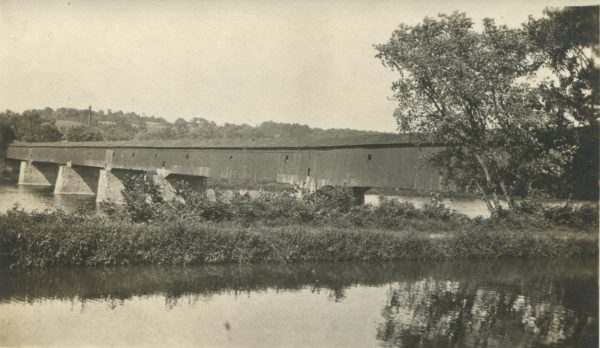
The Centre Bridge as Seen from Pennsylvania Side
Source: Hunterdon County Historical Society, Flemington, N.J.
Structural Details:
The six-span bridge was a covered wooden Town lattice truss design. The barn-like structure was owned by the former Centre Bridge Delaware Bridge Company, a local stockholder concern that had operated a series of wooden bridges at the location for almost 110 years.
Three spans on the Pennsylvania side were constructed by a South Jersey wooden bridge builder named Amos Campbell under a contract award by the former Centre Bridge Delaware Bridge Company in 1829. Campbell’s work is believed to have been completed in 1830, replacing a problematic and apparently uncovered wooden predecessor bridge that opened January 10, 1814. The three Campbell spans were only Centre Bridge portions to survive the devastating “Bridges Freshet” of January 1841 – a flood so named because it partially or completely destroyed five bridges then in operation between Easton, PA. and Trenton, N.J. (Note: As many as two bridges above Easton also were decimated by that January-thaw-induced flood.)
Three spans on the New Jersey side were constructed by Yardleyville, PA. contractor/lumberman/miller Courtland Yardley under a contract issued by the Centre Bridge Company shortly after the flood. (Note: Yardleyville was part of Lower Makefield Twp. at the time; it was incorporated as a separate municipality in 1895.) As part of the contract, Yardley apparently raised the height of the bridge’s supporting abutments and piers by between six and eight feet. This proved propitious as the part-Cambell/part-Yardley Centre Bridge was the only bridge between Easton, PA. and Trenton, N.J. to survive the higher and even-more-devastating “Pumpkin Flood” of October 9-11, 1903.
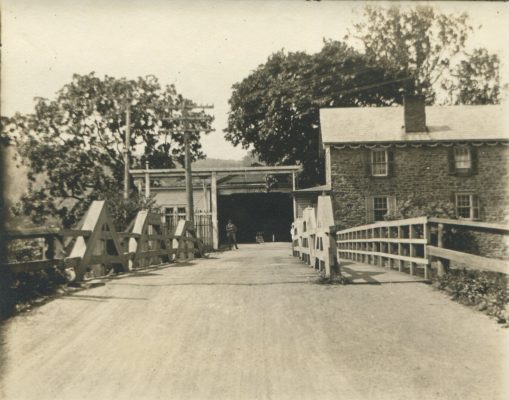
The Centre Bridge New Jersey tolls gate and toll house (undated)
Source: Hunterdon County Historical Society, Flemington, N.J
The Fire:
“15 PLUNGED INTO RIVER TRYING TO SAVE DELAWARE RIVER BRIDGE, HIT BY BOLT,” blared the banner headline in the Trenton Times of July 23, 1923. A stack of sub headlines relayed further urgency: “Covered structure at Stockton falls easy prey to fire. Lightning strikes old span and flames soon reduce it to virtual charcoal; One end collapses carrying fire fighters with it; Hundreds gather to wait news of victims whose lives were in danger; Electric current cut off and workers labor in darkness. Excitement runs high in two towns.”
The accompanying article relayed how 15 men had “escaped from death” when a span of the bridge on the New Jersey side plunged into the river as they were fighting flames.
Elmer Roberson, a Stockton resident at the time, chronicled the event in a pamphlet he produced five years later on the bridge’s history:
“Sunday evening, July 22nd, 1923, during a heavy thunder storm accompanied by high wind and dashing rain, the bridge was struck by lightning and fire broke out on the up-river side, near the first pier from the Pennsylvania shore. The fire, fed by the old shingle roof and dry timbers and fanned by the high wind, spread rapidly. New Hope firemen prevented the fire from spreading to near-by property at the Pennsylvania end. Stockton firemen ran a line of hose out on the bridge and fought the flames from the inside, but their efforts were unsuccessful and they were driven back span by span. They had retreated to the first span on the New Jersey end, which the fire had not reached, when the span, weakened by falling spans farther out, broke off and fell, carrying eight firemen and eight volunteer helpers down to the river bed thirty feet below. Volunteers rushed down the river bank to their aid. When a final checking up was made it was found that although several of the fire fighters were painfully injured, no lives had been lost.”
The Trenton Evening Times article noted that one fireman suffered a broken collarbone and lacerations of the head, shoulder and arm, while another had a nail go through his foot. The article further stated that the rescue took place in dim light, since the fire cut off Stockton’s electricity – which was carried by wires crossing the bridge from the Pennsylvania side.
The newspaper described the bridge’s ultimate demise: “The entire bridge was destroyed, four spans being consumed by flames, while the fifth span collapsed and dropped about thirty feet into the Delaware. After the structure went down, it struck on rocks and sand bars and one end was crushed like an egg shell.”
“When the fifth span fell the firemen saw that it would be of no use to continue fighting the flames, and the bridge was left to the mercy of the blaze. It burned for several hours. The river for a considerable distance down was lit up with burning timber floating down.”
The injured firemen were taken to their respective homes where they were treated by physicians.
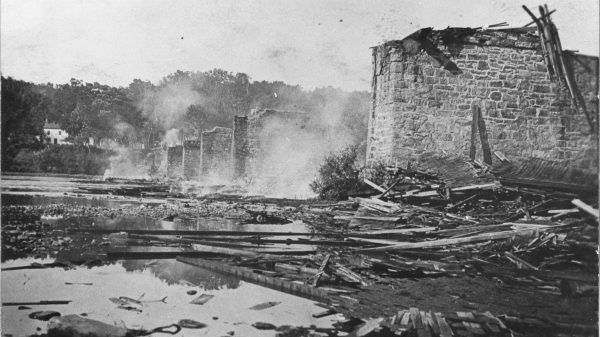
Charred Remnants of the The Centre Bridge – July 23, 1923
Source: Delaware River Joint Toll Bridge Commission Archives
The only photographs of the fire depict the bridge’s smoldering remains on the following day. However, there is a famous painting depicting the blaze as it lit the summer sky – The Burning of Center Bridge. Painted by Edward W. Redfield, an important American impressionist landscape artist and co-founder of a heralded artist colony at nearby New Hope, the canvas is prominently featured at the James A. Michener Art Museum in Doylestown, Pa. Redfield’s home and studio was a short distance upstream of the Centre Bridge.
According to a museum posting, Redfield painted the piece from memory after making notes on an envelope while firemen attempted to extinguish the blaze on the night the bridge was struck by lightning.
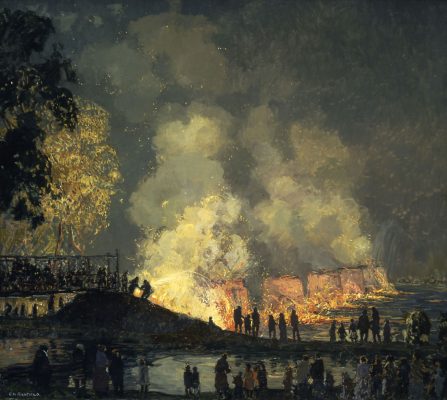
The Burning of Center Bridge
Edward Willis Redfield1923
James A. Michener Art Museum
Doylestown, PA.
Image from Google Arts & Culture:
https://artsandculture.google.com/asset/the-burning-of-center-bridge-edward-w-redfield/mgFLiK0LxFMkMQ?hl=en
At the time of its fateful demise, the venerable Centre Bridge was the oldest remaining 19th Century Delaware River crossing with a timber covered bridge.
After the fire, the stockholders for the old Centre Bridge Company quickly surmised that the insurance would not be sufficient to cover the costs of replacing the bridge. Four years passed before a new bridge was built to once again link the village of Centre Bridge in Solebury, Pa. and Stockton Borough, N.J.
Attachments:
News clippings about the 1923 fire.
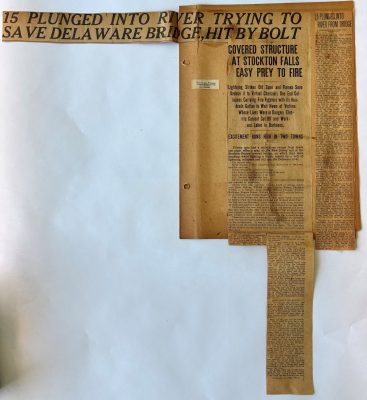
Trenton Evening Times (early edition) – July 23, 1923
Delaware River Joint Toll Bridge Commission archives
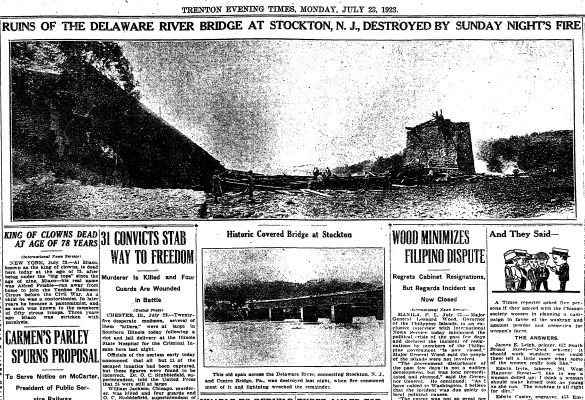
Trenton Evening Times, page 3 – July 23, 1923
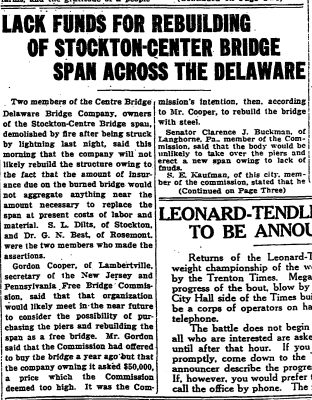
Trenton Evening Times, later edition – July 23, 1923

Trenton Evening Times, later edition (continuation) – July 23, 1923
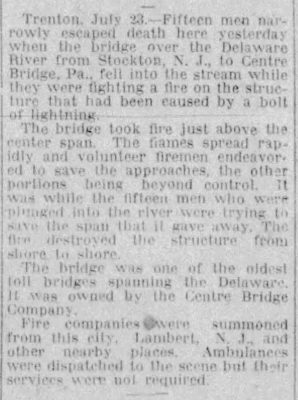
The Jersey Journal (Jersey City, N.J.) – July 23, 1923
Next installment:
The stockholders of the Centre Bridge Delaware Bridge Company vote to sell their surviving real estate holdings to the states of Pennsylvania and New Jersey for $10,000.