
This is one in a series of historical accounts to mark the upcoming 100th anniversary of the Centre Bridge-Stockton Toll-Supported Bridge’s opening on July 16, 1927.
Date: November 6, 1925 (101 years ago tomorrow)
What occurred:
The Commonwealth of Pennsylvania and the State of New Jersey jointly purchased the charred piers and abutments of the former covered wooden Centre Bridge and the associated real estate of the former Centre Bridge Company (also referred to as The Centre Bridge Company and the Centre Bridge Delaware Bridge Company). The bridge had been destroyed in a fire initiated by a lightning strike during an evening thunderstorm on July 22, 1923.
The property transfer cost $10,000 – $5,000 from each state. The transaction was arranged by the former Joint Commission for Elimination of Toll Bridges – Pennsylvania-New Jersey (“the Joint Commission”). The two states fully established the agency in 1916 for purposes of facilitating joint-state purchases of the privately owned toll bridges along the river at that time. The states reconstituted the agency as the Delaware River Joint Toll Bridge Commission (DRJTBC) in late 1934. At the time of the Centre Bridge fire in 1923, the predecessor Joint Commission had facilitated the acquisition of eight former private toll bridges along the river and freed them of tolls.
The process of conveying The Centre Bridge Company’s surviving properties into public hands took more than two years to complete. The following is a detailed account of the chain of events leading to the bridge crossing’s purchase by the two states.
Former wooden bridge details:
The former six-span bridge was a covered wooden Town lattice truss design. The barn-like structure was owned by The Centre Bridge Company, a local stockholder concern that had operated a series of wooden bridges at the location for almost 110 years.
Three spans on the Pennsylvania side were constructed by a South Jersey wooden bridge builder named Amos Campbell under a contract award by the former Centre Bridge Delaware Bridge Company in 1829. Campbell’s work is believed to have been completed in 1830, replacing a problematic and apparently uncovered wooden predecessor bridge that opened January 10, 1814. The three Campbell spans were the only Centre Bridge portions to survive the devastating “Bridges Freshet” of January 1841 – a flood so named because it partially or completely destroyed five bridges then in operation between Easton, PA. and Trenton, N.J. (Note: As many as two bridges above Easton also were decimated by that January-thaw-induced flood.)
Three spans on the New Jersey side were constructed by Yardleyville, PA. contractor/lumberman/miller Courtland Yardley under a contract issued by The Centre Bridge Company shortly after the flood. (Note: Yardleyville was part of Lower Makefield Twp. at the time; it was incorporated as a separate municipality – Yardley Borough — in 1895.) As part of the contract, the contractor apparently raised the height of the Centre Bridge’s supporting abutments and piers by between six and eight feet. This proved propitious as the part-Campbell/part-Yardley Centre Bridge was the only bridge between Easton, PA. and Trenton, N.J. to survive the higher and even-more-devastating “Pumpkin Flood” of October 1903.
The Fire:
Elmer Roberson, a Stockton resident at the time, chronicled the fire in a pamphlet he produced on the bridge’s history:
“Sunday evening, July 22nd, 1923, during a heavy thunder storm accompanied by high wind and dashing rain, the bridge was struck by lightning and fire broke out on the up-river side, near the first pier from the Pennsylvania shore. The fire, fed by the old shingle roof and dry timbers and fanned by the high wind, spread rapidly. New Hope firemen prevented the fire from spreading to near-by property at the Pennsylvania end. Stockton firemen ran a line of hose out on the bridge and fought the flames from the inside, but their efforts were unsuccessful and they were driven back span by span. They had retreated to the first span on the New Jersey end, which the fire had not reached, when the span, weakened by falling spans farther out, broke off and fell, carrying eight firemen and eight volunteer helpers down to the river bed thirty feet below. Volunteers rushed down the river bank to their aid. When a final checking up was made it was found that although several of the fire fighters were painfully injured, no lives had been lost.”
There are no known photographs of the actual bridge fire; the only images show the bridge’s smoldering ruins on the following day. However, there is a famous painting depicting the blaze as it lit the summer sky – The Burning of Center Bridge. Painted by Edward W. Redfield, an important American impressionist landscape artist and co-founder of a heralded artist colony at nearby New Hope. Redfield’s home and studio were a short distance upstream of the Centre Bridge. His canvas is prominently featured at the James A. Michener Art Museum in Doylestown, PA.
At the time of its fateful demise, the venerable Centre Bridge was the oldest remaining 19th Century Delaware River crossing with a timber covered bridge. After the fire, the stockholders for the old Centre Bridge Company quickly surmised that the insurance would not be sufficient to cover the costs of replacing the bridge.
The Centre Bridge Company looks to sell:
A mass meeting of citizens from both sides of the river at the former bridge crossing was held shortly after the fire. Howard Johnson, a Pennsylvania Railroad mail handler who resided in Sergeantsville, N.J. served as president of The Centre Bridge Company at the time. After the meeting, he sent a letter to the Joint Commission stating that the company could not rebuild its bridge. Johnson relayed that a resolution adopted at the meeting requested the Joint Commission to take over the crossing and build a new bridge.
The Joint Commission’s Sept. 21, 1923 meeting minutes chronicle the July fire, the subsequent citizens meeting, and Johnson’s correspondence. The minutes also include the following parenthetical text: “No price was stated officially, but it was reported that the holdings of the Bridge Co. could be bought for about $10,000.”
A Legal Quandary:
The Joint Commission’s secretary – Gordon Cooper of Lambertville – informed the Joint Commission members at their Sept. 21 meeting that he contacted the New Jersey attorney general’s office upon receiving Johnson’s letter. Cooper inquired whether the Joint Commission was legally empowered to help the states acquire properties of a non-functioning bridge. A subsequent letter from New Jersey Assistant Attorney General Judge William Newcorn stated that the legislative acts New Jersey and Pennsylvania enacted to establish the Joint Commission limited the agency to “the elimination of toll bridges that are in existence.”
Based on Newcorn’s opinion, the Commission members directed Cooper to inform The Centre Bridge Company that the agency “can do nothing at present.”
The Joint Commission’s May 26, 1924 meeting minutes provide an update on the Centre Bridge situation, stating that the bridge company offered to sell its surviving properties for $11,500. Those meeting minutes also provide insight on the hardships caused by the Centre Bridge’s demise:
“The Community is badly handicapped. The Stockton post office supplies both towns, and was cut off from Centre Bridge. A large number of Stockton residents are employees of the relay pumping station of the Standard Oil Co. on the Centre Bridge side. These items in addition to the regular interstate traffic. The Commission has been besieged by individuals and organizations, but cannot act in the matter.”
The meeting minutes further explain that the Joint Commission was empowered only to acquire and maintain “bridges over the Delaware on which traffic is maintained and for which tolls are charged.”
The Centre Bridge quandary is again cited in the Joint Commission’s Sept. 26, 1924 meeting minutes, but this time a potential solution is posed. Louis Focht, the Joint Commission’s superintendent and engineer, explains that he talked with the New Jersey Assistant Attorney General Theodore Backes, who wrote the state’s 1912 law to create the Joint Commission. Backes opined that he believed that a Centre Bridge properties purchase could be pursued. The Commission members subsequently requested a new opinion from New Jersey’s legal department, and committed to getting an additional opinion from Pennsylvania’s Attorney General department once the New jersey opinion was received.
Things moved quickly. Four days later — on Sept. 30, 1924 — New Jersey Attorney General Edward L. Katzenbach sent a letter to Joint Commission secretary Cooper outlining the sequence of events and his review of the facts with Backes. Katzenbach then determined that the opinion from the former assistant attorney general (Newcorn) was “erroneous.” Katzenbach concluded as follows: “Under these circumstances, therefore, I have no hesitancy in saying that if the Joint Commission desires to acquire this bridge, there is sufficient warrant in the law for doing so, and that your Commission may repair or restore the bridge in such manner as may be deemed proper by the Commission.”
Next Step: Securing Money to Build a New Bridge
The Joint Commission’s Dec. 19, 1924 meeting minutes note that a budget schedule for 1926-27 had been crafted to include money for purchasing the Centre Bridge properties and constructing a new steel bridge. The Commissioners then resolved to move forward in purchasing the bridge properties and erecting a new bridge between Centre Bridge and Stockton once sufficient funds were secured from the two states.
However, the Joint Commission’s meeting minutes of March 20, 1925 cite a new sticking point: New Jersey Governor George Sebastian Silzer said he was inclined to veto a legislative measure specifically authorizing $100,000 for the Centre Bridge property purchase and the construction of a new bridge. A similar bill also had been introduced in Pennsylvania for $100,000 from that state. Combined, the two appropriations would provide $10,000 for purchasing The Centre Bridge Company’s properties and $190,000 for building a new steel bridge. Due to the uncertainties of the appropriations, the Commission members decided to postpone taking any action on the Centre Bridge matter until their next meeting on June 19, 1925.
The minutes of that meeting spell out how the Joint Commission cobbled together the $200,000 needed to buy the Centre Bridge properties and then construct a new bridge. Pennsylvania would provide $100,000 outright. Meanwhile, New Jersey’s $100,000 match would consist of a reappropriation of $58,000 in unspent funds and an additional $42,000 budget appropriation. The June meeting minutes further mention the receipt of a letter from the bridge company’s president (Johnson). In his letter, Johnson noted that deeds were being prepared. He also listed the utilities crossing the river at the Centre Bridge location. The long-defunct Postal Telegraph Company had 23 wires for which they paid the bridge company $6 per year per wire. The crossing also carried electrical utility wires in exchange for free electricity. The bridge company also rented out fishing rights for $6 a year.
With the prospect of the bridge company’s sale looking more of a possibility, Commission superintendent and chief engineer Focht said it would be necessary to thoroughly inspect the piers and abutments to ascertain if they could bear the weight of an envisioned steel superstructure. The Commissioners voted to offer $10,000 to buy the bridge company’s surviving assets (approaches, real estate, abutments, piers, and a canal bridge on the Pennsylvania side) provided the aged piers could still be used for a new bridge. The bridge company at the time was still seeking $11,500, but the company stockholders agreed to the Commission’s $10,000 offer through a resolution on July 24, 1925.
The Joint Commission’s Sept. 25, 1925 meeting minutes state that title papers were delivered to Focht on Aug. 3 and they were forwarded to the attorneys general in Pennsylvania and New Jersey. The minutes further explain that the Commission had sought bids from contractors to encase the bridge crossing’s stone-masonry piers and abutments in concrete. Six bids had been received and the low bid — $51,000 — from the James S. McCormick Co. of Easton, PA. was approved pending the approval of the bridge company’s purchase by the attorneys for New Jersey and Pennsylvania.
The Real Estate Closing:
The Nov. 6, 1925 sale of the Centre Bridge Company’s surviving real estate holdings occurred in the Doylestown, PA. office of the company’s attorney, Hugh Eastburn, and Bucks County District Attorney Elect Arthur M. Eastburn. The primary attendees were New Jersey Assistant Attorney General Theodore Backes and Isaac J. VanArtsdalen, a prominent Bucks County attorney who represented the state of Pennsylvania in the transaction.
Three officers of The Centre Bridge Company also attended: Howard Johnson, president; Cyrus Bissey, a farmer in Rosemont, N.J. who served as the company’s secretary; and John Ruckman, a property owner in Lahaska, PA. who served as the company’s treasurer.
Attendees from the Joint Commission were Louis Focht, superintendent and chief engineer; S.E. Kaufman, the Commission’s vice chairman; and Gordon Cooper, the Commission’s secretary.
It was a simple transfer of property and money. But before deeds and money exchanged hands, participants first had to address a question posed by the Pennsylvania’s attorney general – George Washington Woodruff – during his review of the impending property sale. Woodruff inquired whether the bridge company’s name was preceded by the definite article “The” in titles, deeds, and other legal papers. Backes presented a copy of the company’s letter patent issued by New Jersey in 1811 that showed the company’s name as “The Centre Bridge Company.” Accordingly, “The” was inserted into deeds and blue prints and instances of the word “Center” were changed to “Centre” in all papers.
Deeds for the actual bridge facilities were then executed in “General” to both states. Deeds of associated real estate in each respective state were then executed to the applicable state. Checks of $5,000 each were then conveyed to the bridge company by the representatives of the two states.
After the property sale, Focht, Kaufman and Backes drove to Stockton, N.J. where contractor James S. McCormick had set up a temporary concrete-mixing operation to encase the stone piers and abutments. Focht informed the contractor’s representative that he could begin work.
Post scripts:
- Later in the month, the Joint Commission advertised for bids from contractors to build a new steel bridge on the soon-to-be-concrete-encased piers and abutments.
- Pennsylvania Attorney General George W. Woodruff had gained fame as a college football player and head coach prior to his legal career. His head coaching posts included the University of Pennsylvania, the University of Illinois at Urbana-Champaign, and the Carlisle Indian Industrial School, compiling a career college football record of 142-25-2. Woodruff’s Penn teams of 1894, 1895, and 1897 have been recognized as national champions. Woodruff was inducted into the College Football Hall of Fame as a coach in 1963. He died on March 23, 1934.
- The Centre Bridge Company’s treasurer, John Ruckman, was a descendant of the prominent Ruckman family of Lahaska, PA. and a renowned collector of American pewter and Chinese art.
- New Jersey Attorney General Edward L. Katzenbach passed away at age 56 in 1934. His wife, Marie Louise, became the first woman president of the New Jersey State Board of Education. A son, Edward L. Katzenbach, Jr. served as a deputy secretary of defense for education and manpower resources in President John F. Kennedy’s administration. Another son, Nicholas Katzenbach, served as U.S. Attorney General during President Lyndon B. Johnson’s administration.
Attachments:
- News clippings about the 1923 fire, image of Edward W. Redfield’s The Burning of Center Bridge, archival bridge photographs, and newspaper clippings from the time of the privately owned bridge properties’ sale to the two states are attached.
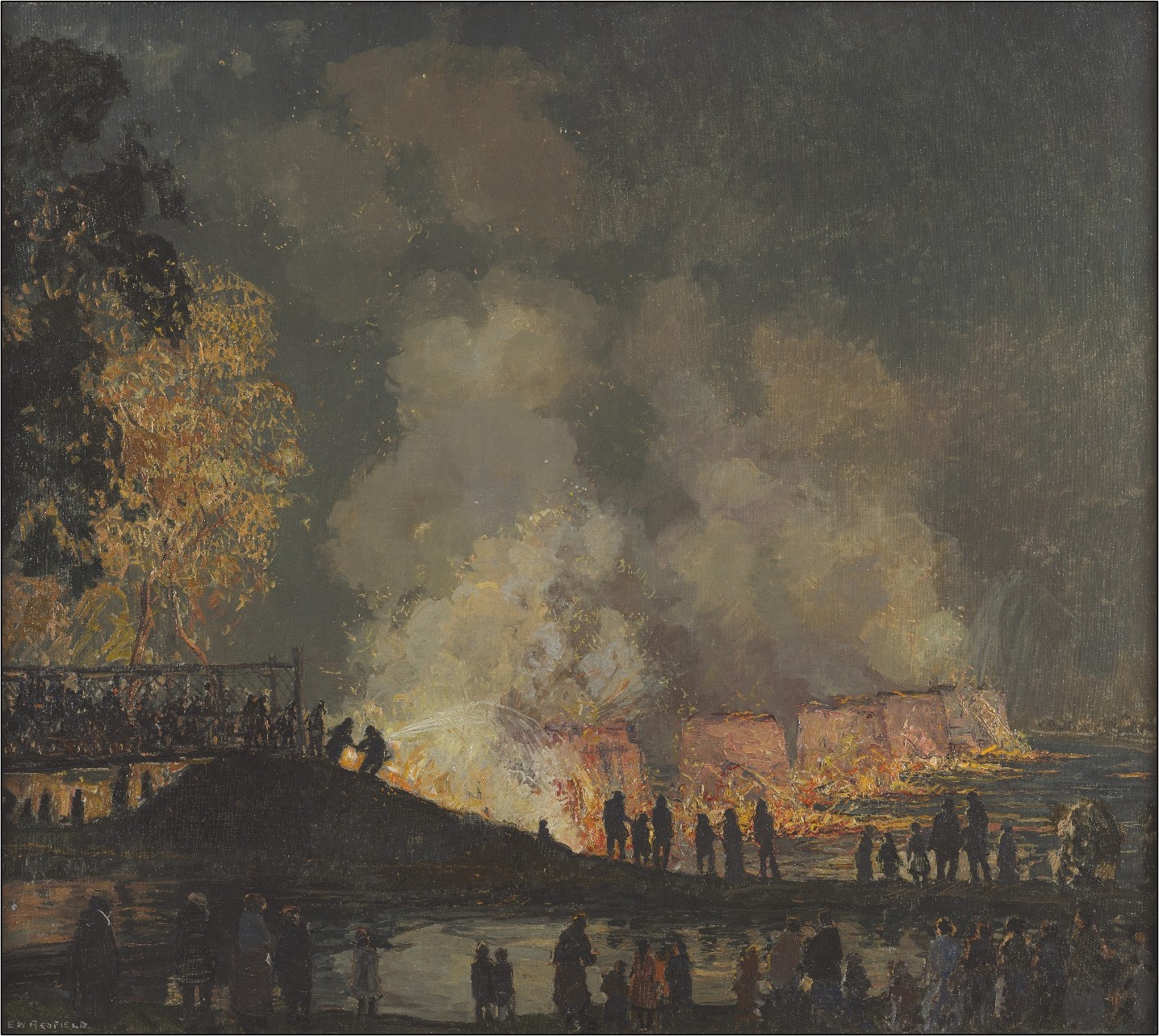
The Burning of Center Bridge
Edward Willis Redfield, 1923
James A. Michener Art Museum
Doylestown, PA.
Image from Google Arts & Culture
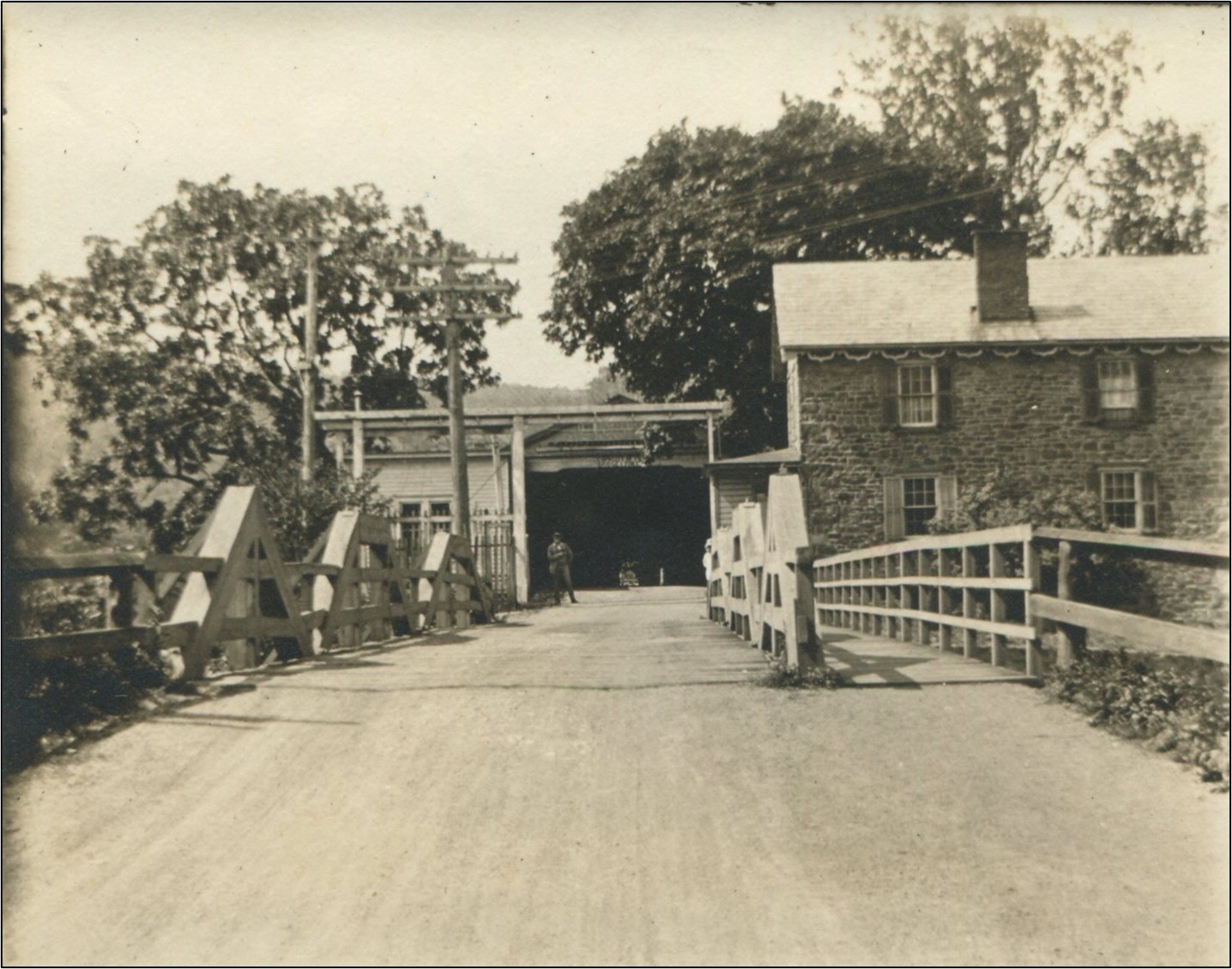
Pre-fire
The Centre Bridge – New Jersey Toll Gate and Toll House (date unknown)
Hunterdon County Historical Society
Flemington, N.J.
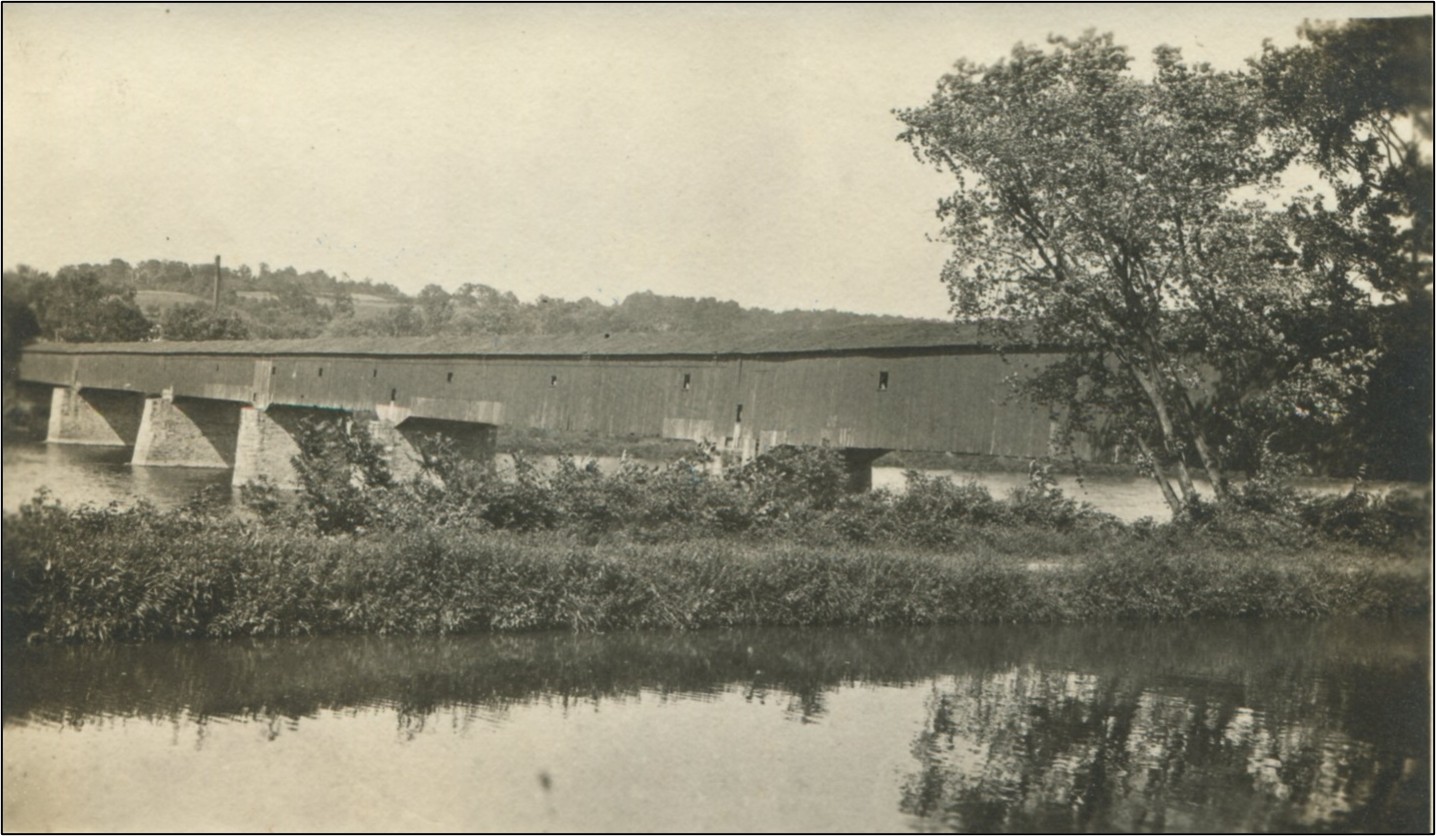
Pre-fire
The Centre Bridge – View from Pennsylvania toward New Jersey (date unknown)
Hunterdon County Historical Society
Flemington, N.J.
Post-fire
Smoldering piers – Believed to be July 23, 1923
Delaware River Joint Toll Bridge Commission archives
Trenton Evening Times, page 3 – July 23, 1923
Post-fire
Trenton Evening Times, later edition – July 23, 1923
Post-fire
Trenton Evening Times, later edition – July 23, 1923
Trenton Evening Times – July 19. 1925
Trenton Evening Times – August 20, 1923
Lambertville Record – October 1, 1925
Lambertville Record – November 12, 1925
Trenton Evening Times – November 21, 1925