TRENTON, N.J. – One of the most heralded works of early-19th century infrastructure – Theodore Burr’s masterpiece covered wooden bridge at Trenton – opened 220 years ago today. It was the first bridge to open across the Delaware River.
The groundbreaking bridge design was heralded as a “nine-day wonder” because people came from near and far to see it during its roughly 70 years of service. Among individuals who came to see the structure were Abraham Lincoln, Alexis de Tocqueville, and Gilbert du Motier, Marquis de Lafayette.
William B. Wilson in his 1895 book, History of the Pennsylvania Railroad Company, described the bridge thusly: “The original bridge, at its completion, was regarded on both sides of the Atlantic as a marvel in bridge architecture, and, in that sense, the finest in the world.”
The bridge was constructed for the long-defunct Trenton Delaware Bridge Company, which was legislatively authorized to be established by New Jersey on March 3, 1798. The legislative measure stated that a “good and permanent bridge across the river Delaware … would greatly contribute to facilitate the intercourse between this State and the Southern States.” Pennsylvania passed corresponding legislation to form the bridge company on April 4, 1798.
The legislative measures designated six individuals to subscribe stockholders for the envisioned company: John Beatty, Peter Gordon, and Aaron Howell of Trenton and Phillip Wagner, James C. Fisher, and Charles Biddle of Philadelphia. Sufficient stock shares were sold to incorporate the company with a president and board of managers on August 16, 1803. A contract to build a bridge subsequently was entered into with Theodore Burr of Oxford, N.Y., who was one of America’s pioneer bridge designers. His namesake “Burr arch-truss” design was patented in 1817 and he claimed to have designed 45 bridges before he died penniless in 1822. He is believed to be buried in a Pennsylvania potters’ field near the Susquehanna River.
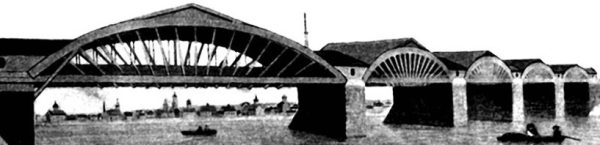
Huge laminated wooden arches were a hallmark element of Burr’s bridge at Trenton, but the structure had many other unique features: open sides, dual cartways, a floor suspended by iron rods from the wooden arches, rooves that ran both perpendicular and parallel to the cartways, breakwater-enhanced masonry piers founded on bedrock, and ornate portals at each end of the bridge. Drawings suggest the bridge was outfitted with one or more lightning rods – an invention of Benjamin Franklin 50 years earlier.
Bridge construction began in 1804. The cost of erection was $180,000, a staggering sum for its day. Costly as it was, stockholders were rewarded with dividends within a few years of the bridge’s completion.
A History of Trenton, published by the Trenton Historical Society in 1929, says the completed bridge was 1,008-feet long between its New Jersey abutment in Trenton and its Pennsylvania abutment on what was then called Delaware Works Island in Morrisville, PA. The bridge was 36-feet wide and it had walkways on both its upstream and downstream sides, with four-foot-high balustrades installed along the adjoining cartways to protect pedestrians from animal-powered vehicles and livestock crossing the bridge. Each roof on the bridge was covered with cedar shingles.
The bridge’s opening was marked with a huge gala. The February 2, 1806 edition of the Trenton-based True American newspaper stated that a field piece stationed on each side of the river commenced firing a national salute of 17 guns each and continued firing while a procession of dignitaries passed over the newly opened bridge.
Tolls were charged to all vehicles, livestock, and pedestrians crossing the bridge. Among the toll rates the private bridge company was allowed to collect – in each direction — were:
- 75 cents – pleasure carriage drawn by four horses;
- 50 cents – pleasure carriage drawn by two horses;
- 62-1/2 cents – stage coach drawn by four horses;
- 37-1/2 cents – stage coach drawn by two horses;
- 62-1/2 cents – loaded wagon drawn by four horses;
- 50 cents – empty wagon drawn by four horses;
- 37-1/2 cents – wagon drawn by two horses;
- 37-1/2 cents – carriage drawn by two horses;
- 25 cents – carriage drawn by one horse;
- 25 cents – sleighs and sleds;
- 12-1/2 cents – single horse and rider (same for every led horse);
- 3 cents – pedestrian;
- 6 cents – every head of mules or horned cattle;
- 1 cent – every sheep or swine.
The bridge held some notable distinctions in its lifetime:
- As previously noted, first bridge completed across the Delaware River;
- Second covered bridge in the United States (first was across the Schuylkill River at Philadelphia);
- First to connect two states;
- First to carry interstate railroad traffic;
- Southernmost bridge along the river for its 70-year lifespan; iron replacement bridge continued that legacy another 50 years, ending with the 1926 opening of the Delaware River Bridge (renamed in honor of Benjamin Franklin in 1956).
New Jersey’s powerful railroad and canal interests (notably the monopolistic Joint Companies) acquired controlling stock ownership of the Trenton Delaware Bridge Company in the mid-1830s as part of a successful effort to block a potentially competing railroad connection between Philadelphia and New York City. It’s believed, or at least estimated, that the bridge was outfitted with railroad tracks in 1839 to carry a horse-drawn rail car in either direction along the bridge’s upstream cartway to connect the Philadelphia and Trenton Railroad terminus in Morrisville and the Camden & Amboy Railroad station in Trenton. A wire-pulled bell at each end of the bridge activated by toll collectors controlled conflicting travel movements on this half of the bridge. This system proved cumbersome and inconvenient.
In 1848, the bridge’s downstream walkway was eliminated. This allowed the bridge’s downstream half to then carry two parallel tracks (one in each direction). The arches on the bridge’s southern side were strengthened with additional arches and supports as part of this process. This allowed the bridge’s upstream cartway to return to strictly non-railroad use, apparently with a more controllable alternating travel system.
In the 1860s, a spark from a passing locomotive ignited a fire on the first span from the New Jersey side and the bridge’s entire shingled roof was removed.
By 1868, the railroad-controlled bridge company realized Burr’s wooden bridge would need to be replaced. Application was made to the two states for legislation that would allow for extension of the bridge’s piers and abutments to the downstream side. Nothing appears to have been done until 1874, when a decision was made to replace the aging wooden bridge with two parallel iron truss structures. By this time, the Trenton Delaware Bridge Company and its bridge were controlled by the powerful Pennsylvania Railroad. The PRR had taken control of both the Camden & Amboy and Philadelphia and Trenton railroads through a 999-year lease in 1871.
The additions to piers and abutments to allow for an iron bridge with two tracks was completed in July 1874. Work on the iron rail bridge was started in December 1874 and completed in August 1875. A History of Trenton provides an account of the ensuing progression that suggests all non-rail vehicular travel ceased at the location for approximately a year:
“The wagon ways of the old bridge were closed in December (1875) and the slow work in dismantling the rotten and rusted bridge began. The piers and abutments were then raised four feet and the iron bridge moved to its permanent site, 18 feet north of where it had been built. This was done by early 1876.”
Apparently, a footwalk was maintained on the downstream side of the bridge during this process. Meanwhile, wagons had to use the covered wooden Trenton City Bridge nine-tenths of a mile upstream until a second iron bridge dedicated for vehicular and pedestrian traffic could be erected immediately upstream of the newly installed iron rail bridge. The second iron bridge was completed in 1876 atop the remaining upstream portions of the piers and abutments that once supported Burr’s landmark former wooden bridge.
Postmortems
The piers and abutments at what is now called Lower Trenton were further widened to the downstream side for the erection of a second rail bridge — a two-track steel-truss structure — in 1892. This resulted in the location having an 1876 two-lane vehicular bridge with an attached pedestrian walkway on the upstream side, an 1875 iron-truss two-track rail bridge in the center, and an 1892 two-track rail bridge on the downstream side. The center iron structure carried trains in the southbound direction and the downstream steel structure carried trains in the northbound direction.
In 1898, the center iron rail bridge was removed and replaced with a two-track steel truss structure. This resulted in the configuration of an 1876 two-lane vehicular bridge with an attached pedestrian walkway on the upstream side, an 1898 steel-truss two-track rail bridge in the center, and an 1892 two-track steel truss rail bridge on the downstream side. The center steel structure carried trains in the southbound direction and the downstream steel structure carried trains in the northbound direction.
The crossing remained with three superstructures until 1903, when the Pennsylvania Railroad opened a four-track stone arch bridge slightly downstream. Lower Trenton’s two steel railroad bridges were dismantled in 1904 and shipped south to the Potomac River, where they were used as continuous spans for the Long Bridge completed in 1905 near Washington, D.C. The former Lower Trenton steel bridge’s spans subsequently remained in service for about 40 more years.
The 1876 “old iron bridge” back at Lower Trenton continued to carry motor vehicles and pedestrians until early 1929. The iron bridge was outfitted with a “Trenton Makes The World Takes” sign illuminated with 2,400 incandescent light bulbs in 1817. The states of Pennsylvania and New Jersey jointly purchased the aging bridge from the Pennsylvania Railroad-controlled Trenton Delaware Bridge Company on May 31, 1918 and immediately freed it of tolls. The purchase was facilitated by the former Joint Commission for Elimination of Toll Bridges – Pennsylvania-New Jersey, the predecessor agency to the current-day Delaware River Joint Toll Bridge Commission.
Using equal shares of tax subsidies provided by the two states, the former Joint Commission designed and oversaw construction of the steel truss vehicular/pedestrian bridge that stands at the Lower Trenton location to this day. The bridge was opened partially to traffic around Thanksgiving 1928 and was completed and fully opened to traffic in both directions in January 1929. A neon Trenton Makes the World Takes sign was installed on the bridge in 1935. The current-day Lower Trenton Bridge’s superstructure largely rests on piers and abutments that constructed for the prior rail bridges erected between 1874 and 1898, The large portions of the piers and abutments that once carried the first wooden bridge and the 1876 iron vehicular/pedestrian bridge were capped with concrete and remain in that state to this day, the last remaining vestige of Burr’s groundbreaking 1806 wooden bridge across the Delaware.
The Trenton City Bridge was destroyed in a spectacular fire June 25, 1884. It was replaced by the wrought-iron, Phoenix-column Calhoun Street Bridge, which opened October 20, 1884 atop the Trenton City Bridge’s surviving masonry piers and abutments.
More reading
The earliest and best drawing of the first bridge across the Delaware River at Trenton was by William Constable – September 10, 1807, and is in the Graphic Arts Collection of Special Collection, Firestone Library, Princeton University: https://graphicarts.princeton.edu/2014/04/02/bridge-on-the-delaware-at-trenton-new-jersey/
The best single article about the bridge probably is Trenton Bridge: Frist Bridge across the Delaware River, written by Frank Griggs, Jr., PE, and appearing in Structure, March 2014: https://www.structuremag.org/article/trenton-bridge-first-bridge-across-the-delaware-river/.
Image in the masthead of this press release is a woodcut engraving that appeared in Historical Collections of the State of New Jersey, 1844, by John W. Barber & Henry Howe.