STOCKTON, N.J. – A special logo has been designed to kick off a 365-day-long countdown to the Centre Bridge-Stockton Toll-Supported Bridge’s 100th anniversary next year, the Delaware River Joint Toll Bridge Commission (DRJTBC) announced today.
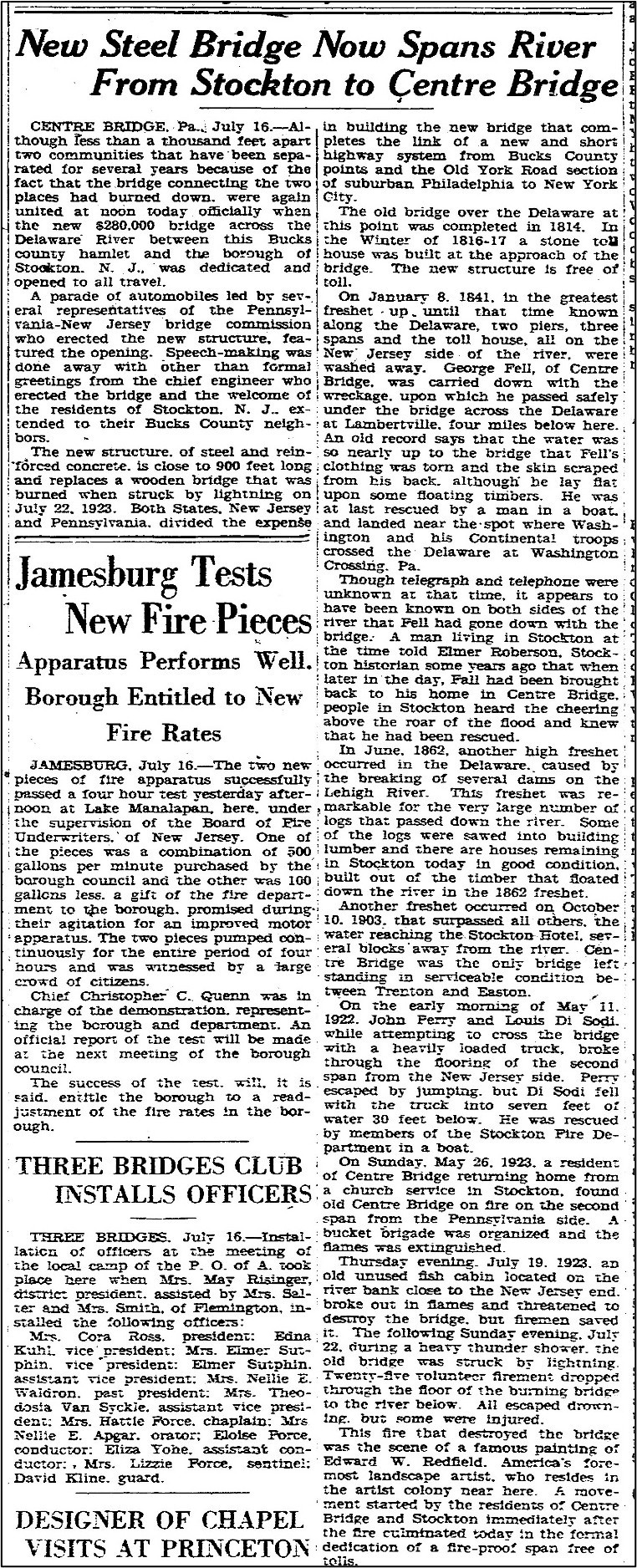
The bridge opened to the public’s use as a free crossing on July 16, 1927. According to published accounts from that time, the bridge’s opening was a low-key affair. The chief engineer who oversaw the bridge’s construction gave brief remarks before colleagues on a former bi-state agency paraded vehicles across the newly completed bridge for the first time. Stockton, N.J. residents also extended a welcome to their Centre Bridge, PA. neighbors who ventured across the bridge for the formal opening.
High temperatures might have been a contributing factor for the largely unheralded event; a stubborn heat wave saturated the area with humidity in early July 1927, when air conditioning was still in its relative infancy.
It’s unclear at this time whether the Commission will do anything beyond developing a logo to commemorate the bridge’s 100th anniversary. During some prior 100-year bridge anniversary years, the Commission has outfitted a respective structure with commemorative banners and assisted host communities that planned and conducted events.
The Commission also has conducted rehabilitations and other projects during the anniversary years of some bridges. This was the case with the New Hope-Lambertville Toll-Supported Bridge when it turned 100 years old in 2004.
A rehabilitation project is not scheduled to be carried out next year at the Centre Bridge-Stockton Bridge. However, it’s possible that planning might begin in 2027 for a rehabilitation project that would be carried out at the bridge in 2028. A decision on that timetable is not expected to be made until later this year or early next year. The bridge was last rehabilitated in 2007.
Current Bridge’s Information and History
The Centre Bridge-Stockton Bridge is the Commission’s eighth oldest structure. It has six steel Warren truss spans of varying lengths. The entire superstructure measures 824 feet, 10 inches between the backwalls of its New Jersey and Pennsylvania abutments.
The bridge was by designed Edwin W. Denzler, Jr., a World War I veteran who later became the Bridge Commission’s chief engineer in the late 1950s and early 1960s. A University of Pennsylvania engineering graduate, Denzler also designed the following four bridges along the river: Lower Trenton (“Trenton Makes”) completed 1929; Uhlerstown-Frenchtown, completed 1931; Upper Black Eddy-Milford, completed 1934; and the Bushkill Street Bridge (since renamed the Easton-Phillipsburg [Route 22] Toll Bridge), completed in 1938.
The bridge between Solebury Township’s Centre Bridge section and the Borough of Stockton was built by the American Bridge Company, which had a major plant along Trenton’s riverfront at the time of the bridge’s construction in 1926 and 1927. The project cost $280,000 and was funded by equal shares of tax revenues that Pennsylvania and New Jersey provided to the former Joint Commission for Elimination of (Private) Toll Bridges – Pennsylvania-New Jersey, the predecessor agency to the DRJTBC.
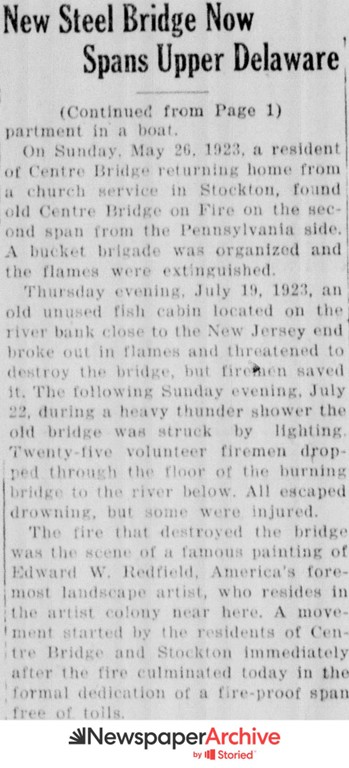
The two states acquired ownership of the river crossing in a transaction arranged by the former Joint Commission in 1925. The states’ purchase from the Centre Bridge Company cost $10,000. It included small land parcels on both sides of the river, an old stone tollhouse on the New Jersey side, a short approach bridge over the canal on the Pennsylvania side, and the old bridge piers and abutments in the river. The piers and abutments were the sole remnants of a prior wooden covered bridge that was destroyed in a spectacular fire sparked by a lightning strike on July 22, 1923.
The new steel bridge was constructed atop the former piers and abutments that supported a series of prior wooden bridges at the location. These stone-masonry substructures were encased with concrete prior to the steel bridge’s erection.
The new bridge consisted of 976 tons of steel and had a concrete roadway deck with 10-foot-wide travel lanes in each direction. The bridge’s toll house, which dated from 1816-1817, was removed in 1952 and replaced by a guard shelter on the downstream side of the bridge’s New Jersey approach. In 1989, that shelter was replaced by the current structure now situated on the upstream side of the New Jersey approach. The bridge’s original concrete roadway deck was replaced with a steel open-grate surface in 1990 and is still in use today.
The bridge originally carried a timber walkway. Over ensuing decades, the walkway was replaced with concrete and later converted back to timber planks. The current composite wood surface was installed in 2017 and features two different plank colors. The meeting point of the two colors marks the location of the state line between Pennsylvania and New Jersey.
The bridge has a 25 MPH speed limit. A five-ton load restriction is enforced by Commission bridge monitors posted at a shelter adjacent to the structure’s New Jersey approach. A traffic signal was installed on the bridge’s Pennsylvania side in 2020 to thwart crossings of oversized vehicles from that direction. The bridge was last inspected in accordance with the National Bridge Inspections Standard earlier this year. An average of 5,100 vehicles crossed the bridge each day in 2025.
River Crossing’s History Dates Back More Than 200 Years
A series of privately owned wooden toll bridges predated the construction of the current Centre Bridge-Stockton Bridge.
Efforts to construct a bridge at the location began with an initial legislative attempt in Pennsylvania and New Jersey in 1809. At that time, only two bridges connected the two states across the river – at Trenton starting in January 1806 and at Easton starting in September 1806. At other points up and down the river, ferries were the only means of crossing.
The 1809 legislative effort for a third Delaware River bridge at what was then called Mitchell’s Ferry proved unsuccessful, largely because of a competing proposal to erect a bridge at nearby New Hope. The competition to be the river’s third bridge location soon became acrimonious. A third competitor near what’s now Lumberville, PA. and Raven Rock, N.J. joined the fray in 1811.
The states’ legislatures eventually decided the issue by appointing a board of commissioners to choose among the three competing proposals. The commissioners settled on the Mitchell’s Ferry location. Its proponents soon applied the name Centre Bridge. It’s unclear if the name referred to the location being roughly halfway between Trenton and Easton or the locations being centered among three ferry locations that competed to be the site of the river’s third bridge crossing.
The Centre Bridge Delaware Bridge Company was chartered in 1812 after enough stock shares were sold to fund the hiring of a contractor to build a bridge. The company’s formation was led by William Mitchell, who operated the ferry and tavern at the location and who later served three terms in Pennsylvania’s House of Representatives. The bridge company soon hired two New Englanders — Peleg Kingsley and Benjamin Lord — to construct the first bridge.
Little is known about that bridge’s design, but bridge company meeting minutes on file with the Hunterdon County Historical Society in Flemington, N.J. suggest it was low-lying, uncovered, and suffered from shoddy workmanship. The company subsequently penalized Kingsley and Lord in excess of $1,000 for their construction shortcomings.
According to an 1812 Centre Bridge Company legal advertisement in a Doylestown newspaper, the bridge opened for use on January 10, 1812. Under the legislative charter approved by the two states, the company charged tolls on everything that crossed the bridge: livestock, horses, animal-powered vehicles, and pedestrians.
While the Centre Bridge served clientele using the York Road routes between New York and Pennsylvania, it struggled financially after a competing and better-constructed bridge opened a mere four miles away at New Hope, PA. in September 1814. The bridge at New Hope also encountered similar financial difficulties.
The Centre Bridge’s inherent structural flaws apparently reached a critical point in 1829 when its stockholders moved to have the structure reconstructed by a well-respected South Jersey covered bridge builder named Amos Campbell. The replacement bridge apparently was a lattice-truss design invented and patented by a Connecticut architect named Ithiel Town.
Campbell’s covered bridge lasted intact for a decade before being decimated in the Delaware River’s “Bridges Freshet” of January 1841. According to later published reports, that flood washed away two masonry piers, three of the bridge’s six spans, and the toll house – all on the bridge’s New Jersey side. A Centre Bridge man serving as a toll taker at the time, George B. Fell, was crossing the bridge at the time its New Jersey spans collapsed. Fell infamously managed to get himself onto floating bridge section, which carried him down the river to near Yardleyville, PA. (now named Yardley) where he was rescued.
The Centre Bridge Company moved quickly and hired Courtland Yardley, a Yardleyville-based contractor/miller/lumber dealer, to reconstruct the bridge. The reconstruction process apparently involved raising the piers and abutments six to eight feet higher and replacing the three missing spans on the New Jersey side.
The post-1841-flood heightening proved propitious. When the Delaware River’s Pumpkin Flood occurred in October 1903, the Centre Bridge was the lone river crossing between Easton and Trenton to survive unscathed. The only other wooden bridge to survive intact along the river between New Jersey and Pennsylvania was the Portland-Columbia Covered Bridge 55 miles upstream.
The Centre Bridge Company continued to operate the aging bridge as a tolled crossing. Soon, motorized vehicles became a new source of toll revenues as they came into wider use during the first two decades of the 20th century.
When the two states formed the Joint Commission to purchase private toll bridges along the river and free them of tolls to handle rising traffic volumes in the late 1910s and early 1920s, the Centre Bridge Company’s directors resisted offers to sell their bridge. This was unfortunate because the bridge was completely destroyed in a spectacular fire after being struck by lightning on the evening of July 22, 1923. Charred stone-masonry piers and abutments were the only remaining vestiges of the series of wooden bridges that served as that location’s river crossing for 109 years.